

Language and currency settings
Change your language and currency settings by selecting your preferences below
Select currency
Select language
In The Press: Nangi in "NRK"

Read the article Norway's largest (and official) broadcasting company, NRK, wrote featuring us and our gorgeous lab-grown diamonds!
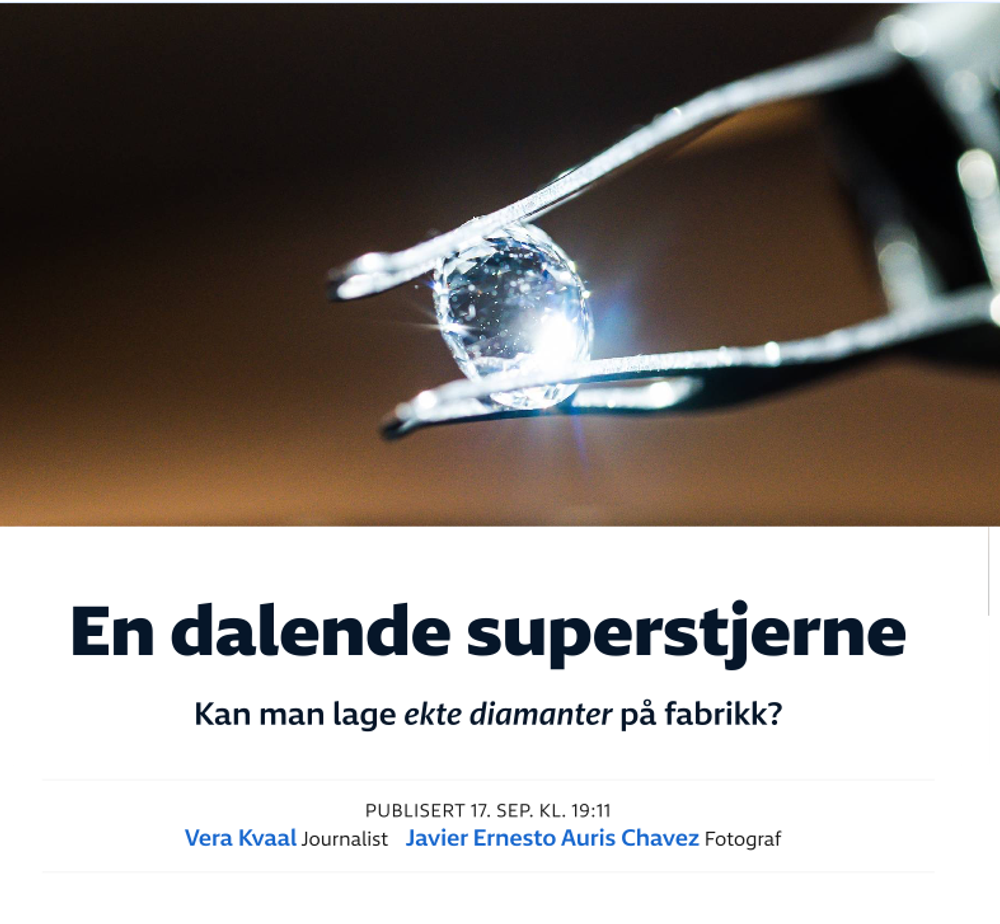
Read the article. NRK (Norway's largest news agency) wrote about Nangi and our sustainable lab grown diamonds! The article is also reproduced below. It was written by Vera Kvaal.
A Fading Superstar
Can real diamonds be made in a factory?
The mighty diamond industry is holding its breath. Something is about to happen that could upend the entire market. Even the value of your own diamond ring is at stake.
In a desperate attempt to regain control, a historic meeting was held in Dubai on July 10. Everyone came: the leaders of the major diamond cartels, mining companies, and ministers from governments in diamond-producing countries.
On the other side of the table in Dubai sat the industry's great fear: the new competitors making diamonds in factories.
The Symbol of Eternal Love
You and I have been brainwashed.
Might as well admit it: we're all victims of the boldest, longest-running advertising campaign in the world. The company behind it is the diamond producer De Beers.
They've managed to convince us that a diamond is a wholly unique product of nature, and therefore a symbol of eternal love.
But it hasn't always been this way. They planted that idea in your head.
De Beers was founded in 1888 by Cecil Rhodes (yes, the same man who gave his name to Rhodesia, now Zambia and Zimbabwe).
Up until the 2000s, De Beers controlled more than 80 percent of the world's diamond trade.
As early as 1938, De Beers hired the advertising agency N.W. Ayer & Son.
Before that, diamonds had been a luxury product reserved for the very wealthy, but De Beers wanted to expand the market so that people with ordinary incomes would want to buy diamonds too.
The advertising team came up with a plan.
They wanted to connect diamonds to consumers' emotions, and they chose the strongest one of all:
Eternal love.
The thing we all dream of.
So they launched the slogan "A Diamond Is Forever" (voted the best advertising slogan of the last century) and insisted that only a diamond could symbolize the unique love you feel for the one you love.
At the same time, they showered Hollywood celebrities with diamonds.
De Beers even went so far as to specify exactly how much money a man in love should spend on a diamond engagement ring: two months' salary was deemed appropriate.
The campaign linking love, marriage, and diamonds worked remarkably well.
Today, 90 percent of all engagement rings in the US are set with diamonds, and the average price per ring in 2020 was just under NOK 40,000.
De Beers is no longer alone in the diamond market. Several new producers have established themselves, and the market is big enough for many players.
Zion Market Research has estimated the total value of the diamond industry at a staggering NOK 970 billion. (I've thought a bit about how to convey a number that large. It's genuinely tricky, but there are at least nine zeros behind it, and that's a lot.)
But what happens to that value now, as synthetic diamonds flood the market?
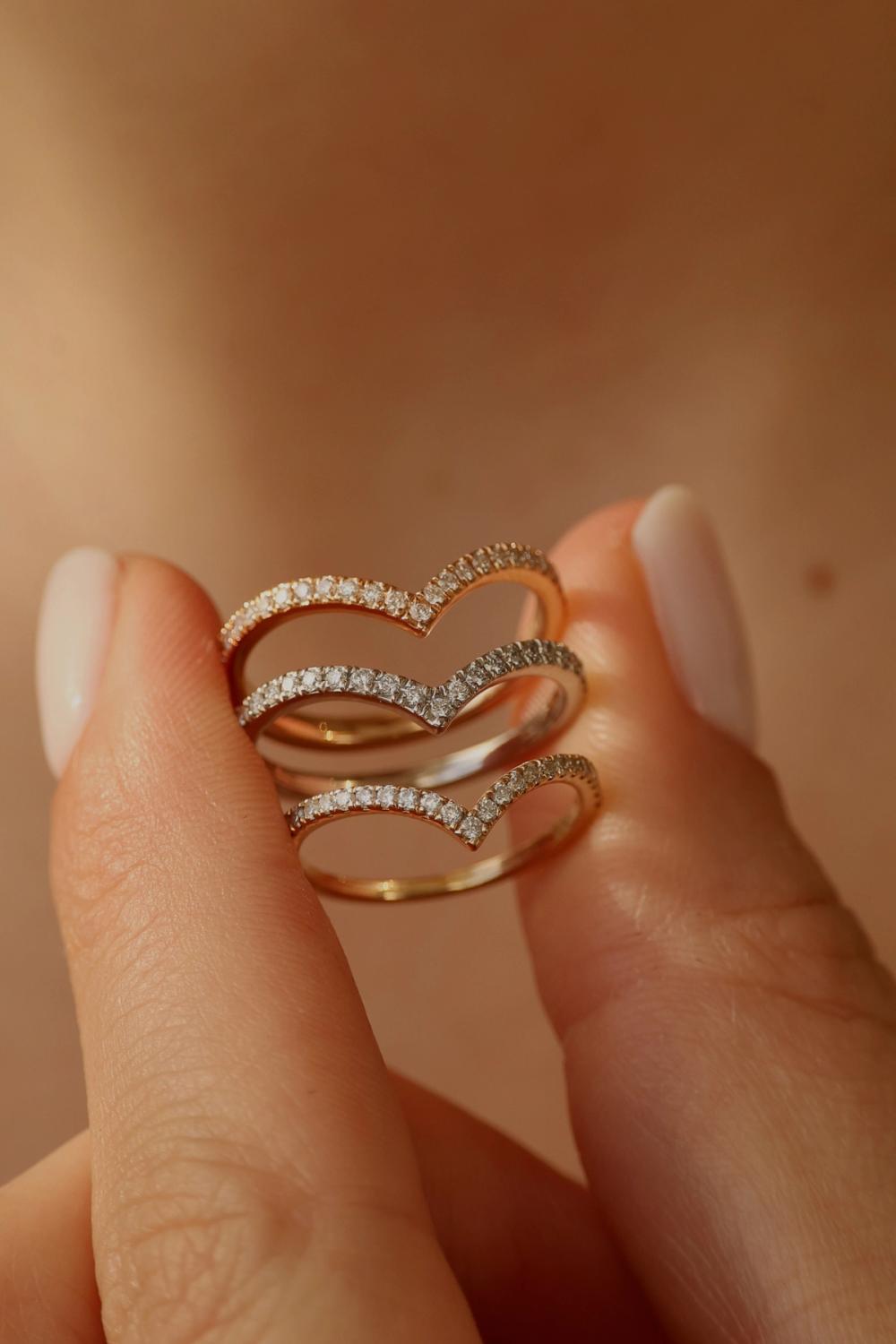
Above: Nangi Diamond Swan Tail Ring in 14K yellow, white, and rose gold.
Ethical diamonds
"I need to correct you on something."
Jenny Gørvell-Dahll smiles warmly before telling me they aren't called synthetic diamonds.
"They're called lab grown."

Gørvell-Dahll and her husband run the jewelry company Nangi. They've specialized in lab grown diamonds and designed their own jewelry collection.
"The word synthetic makes it sound fake, like it's not a real diamond. But it is a diamond, even though it's man-made," says Jenny.
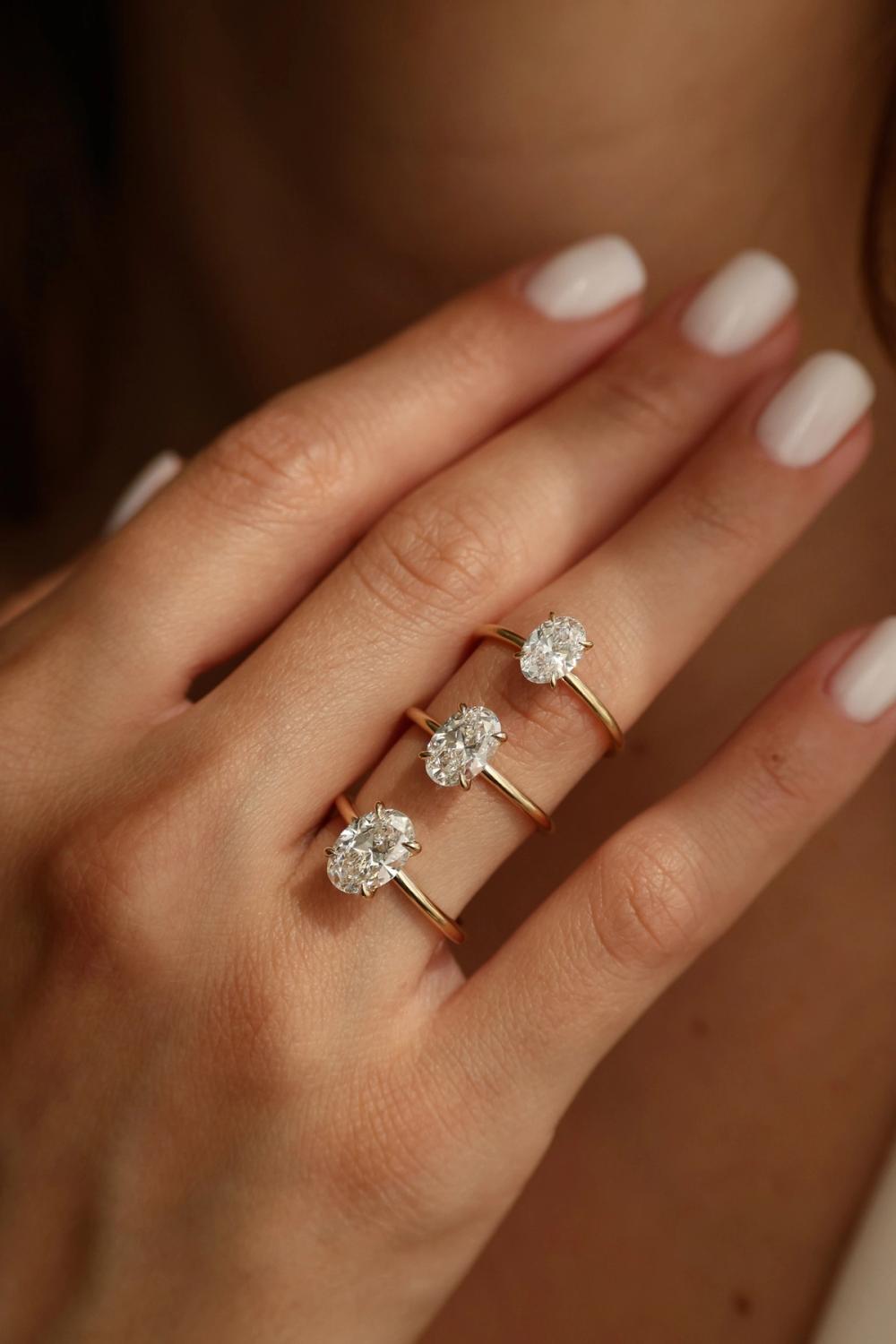
Over: Swan Oval Diamond in 14K Solid Yellow Gold
LAB GROWN DIAMONDS: Not synthetic, in other words.
She and her husband were early to make jewelry with factory-produced diamonds. Their goal was to sell ethical jewelry.
Why?
Because the history of the diamond industry has been, and still is, brutal.
Mining conditions are horrific, basic human rights are violated, and the environmental damage is massive. On top of that, there's money laundering and the financing of terrorist groups.
In 2008, the Zimbabwean government sent in helicopters and shot 150 miners from the air. The conditions in these mines were the basis for the film Blood Diamond.
Jenny Gørvell-Dahll hopes to avoid all of this with her products, and it seems customers are buying the argument: every indicator is pointing up for the small jewelry company.
"Our typical customer is a young, urban, highly educated woman buying a ring for herself."
Jenny looks like a living version of the customer she just described.

"But it's not exactly eco-friendly to use huge amounts of energy making an expensive, unnecessary product?"
"Of course diamonds cost energy. It's an exclusive product. But it's significantly less harmful to people and the environment to produce them in a reactor," says Jenny, pointing out that several factories now produce diamonds using pure solar power.
Still, some customers feel a man-made gemstone is less impressive than a natural diamond.
It's happened that men in love have second thoughts standing in the store. Will the woman he loves be disappointed that the gemstone wasn't formed by nature?
"But just think how much bigger a diamond she can get for the same price," Jenny Gørvell-Dahll smiles.
Because a natural diamond and a lab grown diamond don't cost the same.
I'll come back to that, but first you need to know how a diamond is made.
Here's How It's Done
Here's the recipe, and you might want to read this part slowly if you're not a physicist.
A diamond is a crystal. A crystal is a repeating structure of atoms. If you have carbon arranged in a repeating pattern, formed under high pressure and high temperature, that's a diamond.
This happens when carbon is subjected to extreme heat and pressure hundreds of kilometers below the earth's surface. Massive volcanoes have spewed out the planet's contents, diamonds along with everything else. In nature, this process can take up to 3 billion years.
The exact same process can be recreated in a laboratory. A tiny diamond, called a diamond seed, is placed inside a reactor that mimics the conditions of the earth's interior. The carbon atoms in the reactor are drawn to the seed, and the crystal grows.
An efficient reactor is said to be able to grow a rough diamond by one carat a day.
There are several methods for producing diamonds artificially, but the end result is a 100 percent pure diamond. They can even turn out "better" than natural ones, since it's now possible to produce completely pure diamonds with no inclusions (the small impurities from deep within the earth that are common in natural diamonds).
Nature is rarely as pure as a man-made laboratory.
The Diamond Appraiser
Maria Kath Schenk is a graduate gemologist who makes her living appraising gemstones for customers.
"Of course customers come in here and end up disappointed."

"It's incredibly easy to get fooled if you don't know the market."
Schenk has worked appraising gemstones for 20 years. Before that, she earned a doctorate in fair trade economics and worked with silver in Mexico.
"One rule of thumb when buying a diamond: stay away from bargain sales. At the very least, you have no idea what you're getting," she says.
That's because a natural diamond and a factory-made one are priced very differently.

WHAT THE EYE CAN'T SEE: Every diamond over 0.2 carats has a number engraved on its girdle, readable under a microscope. This applies to both natural and lab grown diamonds, and it's how origin and place of production are tracked.
A natural diamond costs around $10,000 per carat. A man-made diamond was going for $800 per carat before summer.
And prices are expected to drop further, since diamonds have enormous industrial value. Researchers at the University of Bergen are studying new ways to use diamond as a raw material. Carbon is an excellent conductor.
Whether the city will also become a hub for producing jewelry diamonds remains to be seen.
Then the appraiser changes the subject.
"Have you seen the world's largest office building?"
I shake my head.
"Come here, I'll show you."
Maria pulls up a photo of the Surat Diamond Bourse, the world's largest office complex.
It's scheduled to open on November 21, 2023, at which point 67,000 diamond workers will report to these buildings for work.
India is investing heavily to make Surat the world's diamond capital for both man-made and natural diamonds.
"I need to go there soon," says Schenk.
How Is a Diamond Evaluated?
A diamond is evaluated on four criteria: size, clarity, color, and cut.
The first three categories describe the raw material. Cutting is craftsmanship, and many of the workers in Surat will spend their careers cutting diamonds.
A rough diamond is a dull-looking gemstone in its natural state. It's simply excellent raw material.

BEFORE AND AFTER: Believe it or not, both of these are diamonds. The square on the left is an uncut diamond grown in a reactor. The one on the right is the same stone after cutting.
The secret lies in how the crystal reacts to light. To achieve this effect, small flat surfaces called facets are cut into the stone. An optimal diamond has 57 facets.
That's what allows the gemstone to catch every ray of light and sparkle, even by the light of a single candle.
In Maria Kath Schenk's office, I'm put to the test. She lays three small diamonds in front of me and asks me to figure out which one occurred naturally.

It's impossible, of course. The tiny gemstones look identical to the naked eye.
Determining how a diamond was made requires advanced measuring equipment. The diamond industry has spent a great deal of money on technology that can detect lab grown diamonds.
Even so, no single test can give a 100 percent certain answer, which is why Schenk uses several different types of instruments.

TESTING EQUIPMENT: No single tester guarantees complete accuracy, so Maria Kath Schenk has acquired several different kinds.
"When the first man-made diamonds hit the market, they were easier to spot. Some of them were magnetic because they contained traces of iron."
Schenk brings out the powerful magnet she used to rely on a few years back. She passes it low over the table with the three diamonds, and sure enough, one of them leaps up and sticks to the magnet.
"This doesn't happen much anymore," she says, since producers have kept getting better at what they do. Diamonds are rarely magnetic now.
"As an expert, what do you think of man-made diamonds?"
"I have nothing against them, as long as sellers disclose what's what," says the appraiser, pointing to how pearls went through the same shift.
She believes everyone benefits from more transparency in an industry that's historically been very closed and secretive.
Then she tells me a story meant to illustrate what's happening in the diamond market right now:
A friend of hers was a flight attendant in the 1970s. During a layover in Thailand, she went out into the jungle and picked some orchids. She carried them back to Europe in a bag and sold them for thousands of kroner, because orchids were incredibly rare back then. Now, 50 years later, anyone can buy a cheap orchid at the store that was grown right in Europe.
Are those greenhouse-grown flowers any different from the ones that grow wild on tree trunks in Thailand?
The question hangs in the air.
Then the appraiser laughs.

"It's still an orchid either way, isn't it?"
The Meeting in Dubai
July's diamond meeting in Dubai was historic. It was the first time the diamond cartels sat down face to face with their new rivals. Ever since the first man-made diamond was created in 1953, the cartels had managed to keep these gemstones out of the jewelry market, restricting them to industrial use.
That's no longer possible. There are simply too many producers now, and the quality of the product has improved. So talking to each other is the next best option.
Observers at the meeting describe major changes on several fronts, including something as simple as how attendees dressed. Where it used to be nothing but older men in dark suits, the new producers showed up in jeans. It's a fitting picture of the new era in the diamond industry.
And it's no coincidence the meeting was held in Dubai. The Arab world has become a major buyer of bling, but without the same mythology attached to the diamond as a symbol. (Read: they were never subjected to De Beers' advertising.)
The Arab world wants the diamond itself as a product, and once it can be grown, spectacular bling becomes possible.
The Dubai meeting didn't produce any concrete agreements, but industry sources claim international standards for pricing and quality are coming in 2024.
Even the diamond giant De Beers has launched its own jewelry collection with man-made diamonds: Lightbox, a line aimed at teenagers and kept strictly separate from the rest of their products.
While working on this article, I tried to find someone willing to go on record saying man-made diamonds are a bad thing. There's no shortage of people who get angry in private when I bring it up. They shout down the phone that they don't want to talk to the press, turn red in the face when I ask about it in the jewelry store, or insist the two products are so different they can't even be compared.
And yet not one person I've met is willing to say any of this publicly.
We're now standing at a crossroads in diamond production, and no one can say for certain whether the value of your diamond ring will hold.
Just before I filed this article, news broke that natural diamond prices had dropped five percent (a press release from Rapaport). Whether this is temporary or signals a real trend remains to be seen. But once diamonds can be made in a factory, does the feeling of owning a one-of-a-kind product of nature start to disappear?
Only time will tell whether these sparkling crystals eventually become as ordinary as any piece of glass.
P.S.
While working on this story, I was reminded of something I once heard about Napoleon's son's rattle. When little Louis was born, his father wanted the boy to have a rattle made from the finest material on earth. Even gold wasn't good enough for his son, Napoleon felt. He wanted the most exquisite material available on the market at that moment.
His son's rattle was made of aluminum.
Join the Nangi family!
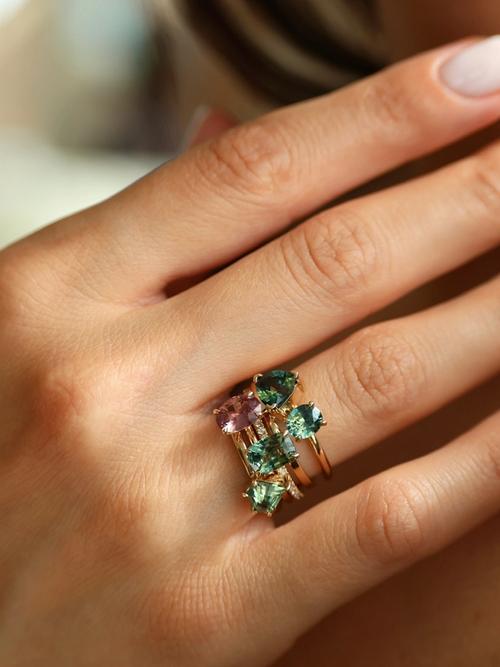


Join the Nangi family!
Subscribe to our newsletter to be the first to know when we release new one-of-a-kind pieces, and gain exclusive access to archive sales and events
Visit us
The House of Nangi
Halvdan Svartes Gate 3 | Oslo, Norway
Thursday | 11:00-18:00
Monday - Sunday |
by appointment
Connect
Norsk side
Nangi Fine Jewelry © 2026